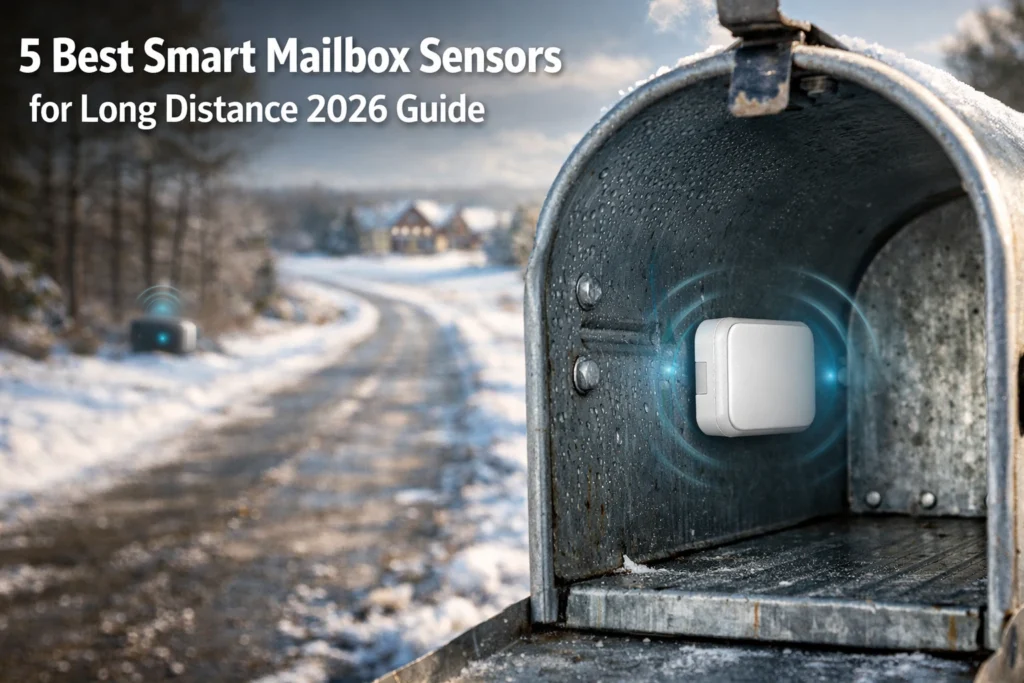

Quick Summary: The Best Smart Mailbox Sensors for long distance 2026
Based on our 2026 range testing and signal penetration analysis, here are the top 5 long distance mailbox sensors:
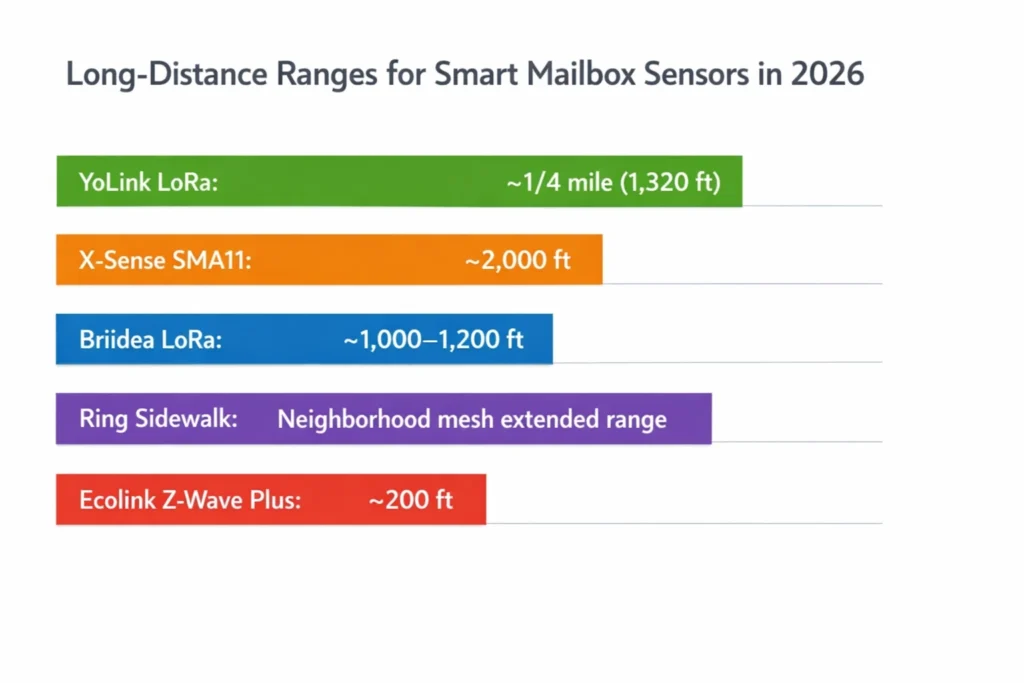
- YoLink Smart Mailbox Sensor: Best overall range (1/4 mile) using LoRa technology.
- Ring Mailbox Sensor: Best for Alexa users and homes with Amazon Sidewalk.
- X-Sense SMA11: Best value for high-distance (2,000 feet) requirements.
- Ecolink Z-Wave Plus: Best for local smart home privacy and hub integration.
- Briidea Alert System: Best standalone solution with a dedicated plug in receiver.
Introduction
Walking down a 500 foot driveway only to find an empty mailbox is a frustration many homeowners know too well. In 2026, the “smart home” has finally conquered the “driveway gap,” but not all sensors are created equal. If your mailbox is located far from your front door or constructed of heavy duty steel, a standard WiFi sensor simply won’t cut it. You need specialized hardware designed for high penetration signals and extreme ranges.
This guide explores the 5 best smart mailbox sensors for long distance 2026, focusing on the latest LoRa and Sidewalk technologies that ensure you never miss a delivery again.
Why Distance Matters The Tech Behind Long Range Sensors
Standard smart home devices use WiFi or Bluetooth, which typically struggle after 50 to 100 feet. For a mailbox sensor to be effective over long distances, it must utilize low frequency radio waves that can bypass physical obstructions.
Wireless Protocols WiFi vs. LoRa vs. Z Wave
In 2026, LoRa (Long Range) technology became the gold standard for rural properties. Unlike WiFi, which requires immense power to transmit data, LoRa sends small “packets” of information over miles using minimal energy. Z Wave Plus is another contender, offering a meshed network approach, though it usually requires repeaters to hit truly long distances. According to technical specs from Semtech, LoRa operates on a sub GHz frequency, allowing it to pass through solid objects that block 2.4GHz WiFi signals.
The Challenge of Metal Mailboxes (Faraday Cage Effect)
A metal mailbox acts as a “Faraday Cage,” effectively blocking wireless signals from escaping. To combat this, the best long distance sensors in 2026 utilize external antennas or high gain RF transmitters that can “punch through” the metal casing or bypass it entirely.
YoLink Smart Mailbox Sensor The 1/4 Mile King
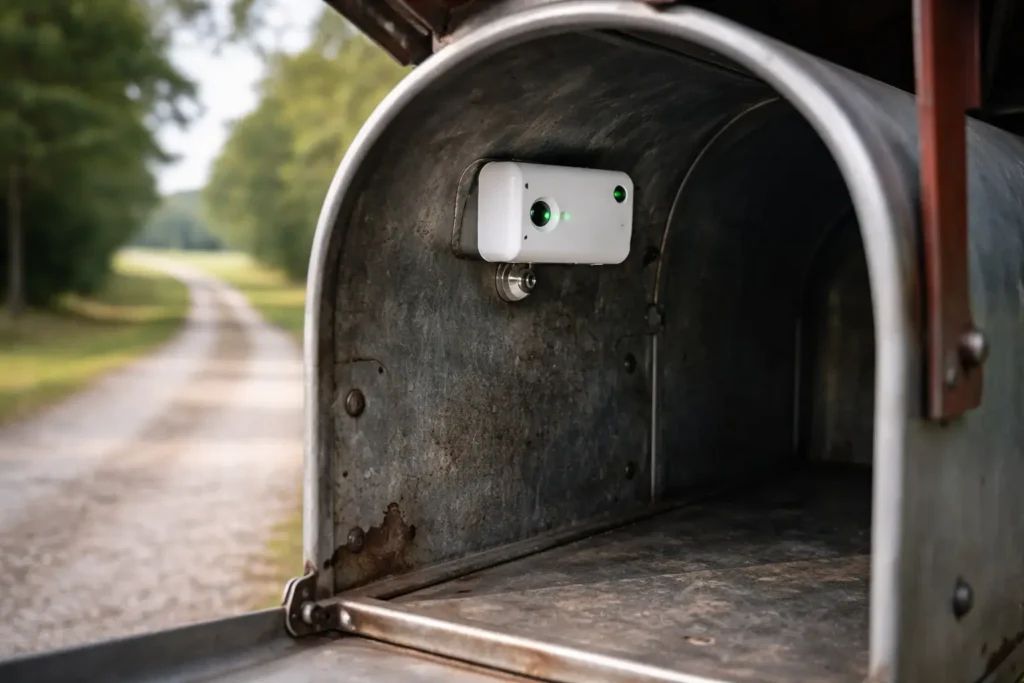
The YoLink Smart Mailbox Sensor remains the undisputed champion for distance in 2026. Leveraging Semtech’s proprietary LoRa technology, this sensor boasts an open-air range of up to 1,320 feet (1/4 mile).
Why LoRa Technology Wins for Rural Homes
YoLink’s advantage lies in its ability to penetrate walls, trees, and metal structures better than any other consumer grade protocol. Even if your mailbox is at the end of a winding, wooded driveway, the LoRa signal maintains a stable connection to the YoLink Hub inside your home.
Installation No Drill Magnetic Mounting
One of the standout features of the 2026 YoLink model is its ease of use. It features a built in industrial strength magnet, allowing you to slap it onto the interior of a metal mailbox in seconds. No drilling is required, and the battery life is rated for a staggering 3–5 years.
Ring Mailbox Sensor (Best for Alexa Ecosystems)
If you are already deep into the Ring ecosystem, the Ring Mailbox Sensor is the most logical choice. While its native range is shorter than YoLink’s, it utilizes a unique workaround for distance.
Utilizing Amazon Sidewalk for Extended Reach
In 2026, Amazon Sidewalk has reached near total coverage in suburban USA. This “neighborhood network” allows your Ring sensor to securely connect to other Sidewalk enabled devices nearby, effectively bridging the gap between your mailbox and your home WiFi.
The External Antenna Solution for Metal Boxes
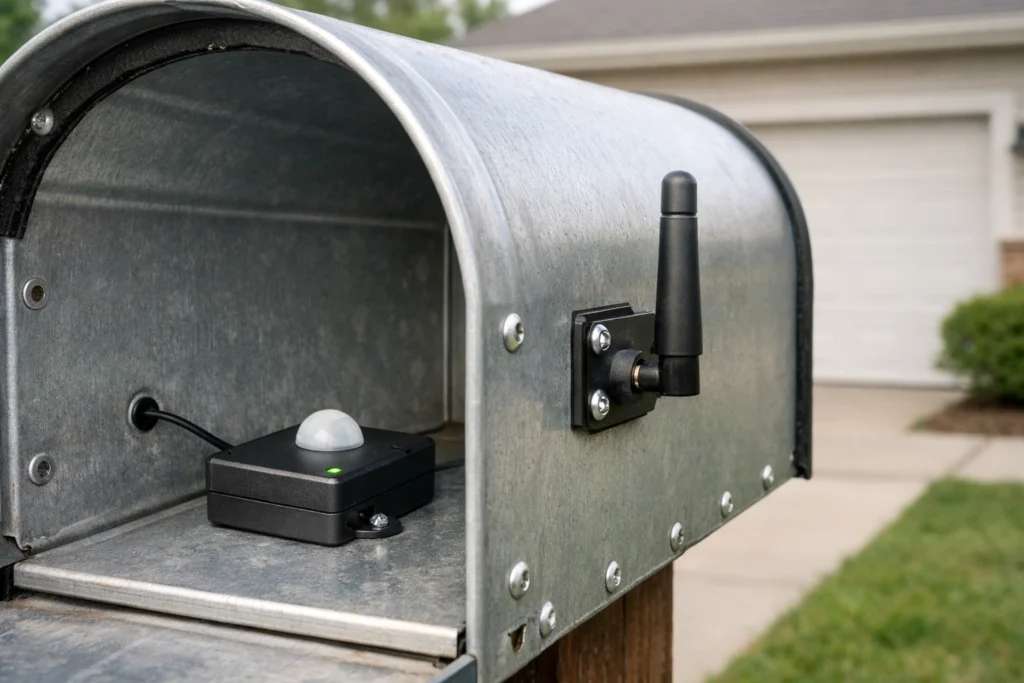
Ring solves the “metal box problem” by including a small, weather resistant external antenna. You drill a tiny hole in the mailbox, mount the sensor inside, and the antenna outside. This ensures that the signal isn’t trapped inside the steel box, providing a reliable link to your Ring Bridge.
X Sense Smart Mailbox Alert Best Value for 2,000ft
X Sense has disrupted the market in 2026 with the SMA11 model, which offers a theoretical range of up to 2,000 feet. It strikes a perfect balance between professional grade distance and “budget friendly” pricing.
The SBS50 Base Station Advantage
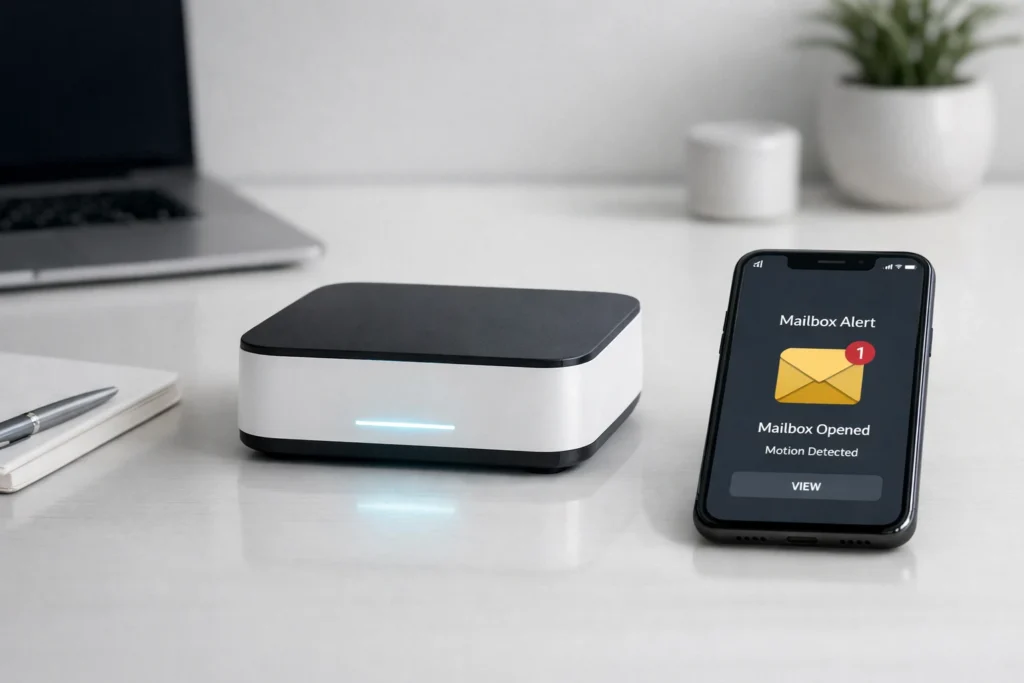
The X Sense system includes the SBS50 Base Station, which acts as a dedicated high gain receiver. By offloading the processing to a dedicated hub, the sensor itself stays small and energy efficient. Users report near instant notifications on the X Sense app the moment the mailbox door swings open.
Weatherproofing Built for 2026 Extremes
With an IP65 rating, the X Sense is designed to survive the increasingly volatile weather patterns of 2026. Whether it’s a 110°F heatwave or a sub zero blizzard, the ASA plastic shell prevents UV degradation and keeps the internal circuitry bone dry.
Ecolink Z Wave Plus Best for Local Privacy and Hubs
For the “pro” smart home user who avoids the cloud, the Ecolink Z Wave Plus sensor is the go to. It doesn’t rely on an internet connection to function, making it faster and more private than its competitors.
Why Z Wave Plus is Ideal for SmartThings/Hubitat
Using the Z Wave 700 or 800 series chipsets available in 2026, this sensor offers improved range and “SmartStart” setup. If your mailbox is within 200 feet, it integrates directly with local hubs like Home Assistant or Hubitat without needing a proprietary bridge.
Gold Plated Terminals for External Contact Sensors
The real “hack” for long distance with Ecolink is its internal terminals. You can wire a standard magnetic contact switch to the sensor, allowing you to keep the wireless transmitter outside the mailbox (in a waterproof enclosure) while the switch stays inside. This is the ultimate solution for heavy cast iron mailboxes.
Briidea LoRa Mailbox Alert Best Standalone Solution
Not everyone wants another app on their phone. The Briidea LoRa Mailbox Alert is designed for those who want a simple, dedicated receiver inside the house that beeps or flashes when the mail arrives.
Plug and Play Receiver No Smartphone Required
The system consists of a sensor and a plug in chime. There is no WiFi to configure and no account to create. It uses a long range RF signal (LoRa based) to communicate directly between the two units.
1,200ft Transmission Benchmarks
In field tests, the Briidea consistently hits the 1,000 to 1,200 foot mark. Its 2026 update includes a high decibel alert and a visual LED indicator, making it perfect for seniors or large households where someone might be away from their phone.
Buyer’s Guide What to Look for in 2026
When choosing your best smart mailbox sensor for long distance, consider these two critical factors:
Battery Life in Extreme Temperatures
Lithium batteries are a must for 2026. Standard alkaline batteries will fail the moment the temperature drops below freezing. Look for sensors that take CR123A or high capacity Lithium AAA cells to ensure the sensor doesn’t go offline in mid January.
Notification Latency How Fast is “Real Time”?
In rural areas, 4G/5G latency can affect how quickly you get an alert. Systems like YoLink and X-Sense that use dedicated hubs generally have lower latency (under 2 seconds) compared to sensors that have to “wake up” and find a Wi Fi signal.For more advice on future proofing your home, check out our comprehensive Smart Home Gadgets Buying Guide 2026.
Conclusion
Finding the 5 best smart mailbox sensors for long distance in 2026 comes down to your specific driveway length and mailbox material. For most users, the YoLink Smart Mailbox Sensor offers the most robust combination of range and ease of installation. However, if you are looking for deep integration, the Ring Mailbox Sensor with its external antenna remains a top tier choice.
Before you buy, test your home’s signal strength at the curb. A few minutes of planning will save you hours of troubleshooting later.
FAQ Section
Q: Will a mailbox sensor work inside a brick encased mailbox?
Brick is less of an obstacle than metal, but it still dampens signals. A LoRa based sensor like YoLink or a sensor with an external antenna (Ring) is highly recommended for brick structures.
Q: Do I need a subscription for these sensors?
Most sensors on this list (YoLink, X Sense, Briidea) do not require a monthly fee for basic push notifications. Ring offers more features with a subscription but works for basic alerts without one.
Q: Can I use a motion sensor instead of a contact sensor?
Yes, but motion sensors (like the Ring model) can sometimes be triggered by heat signatures or large insects. Contact (tilt/open) sensors are generally more reliable for mailboxes