
The battle for the high end PC crown often comes down to NVIDIA’s flagship cards. Even with newer models emerging, the comparison between the RTX 3090 vs Rtx 4090 remains one of the most hotly debated topics for enthusiasts and professionals alike. Both cards represent the pinnacle of their respective generations, offering unparalleled performance. But in 2025, one is a powerhouse deal, and the other is simply the powerhouse. This guide will break down the architectural differences, analyze the performance gap in 4K gaming and creative workloads, and help you determine which GPU should you buy in 2025.
Architectural Foundation Ampere vs Ada Lovelace
At the heart of the performance difference is the generational leap in architecture. The RTX 3090 is built on the Ampere architecture, which was a significant jump for ray tracing and traditional rasterization. The RTX 4090, however, utilizes the Ada Lovelace architecture, featuring numerous refinements that deliver greater power at lower thermal demands. This includes improved Streaming Multiprocessors (SMs), third generation Ray Tracing cores, and fourth generation Tensor cores.
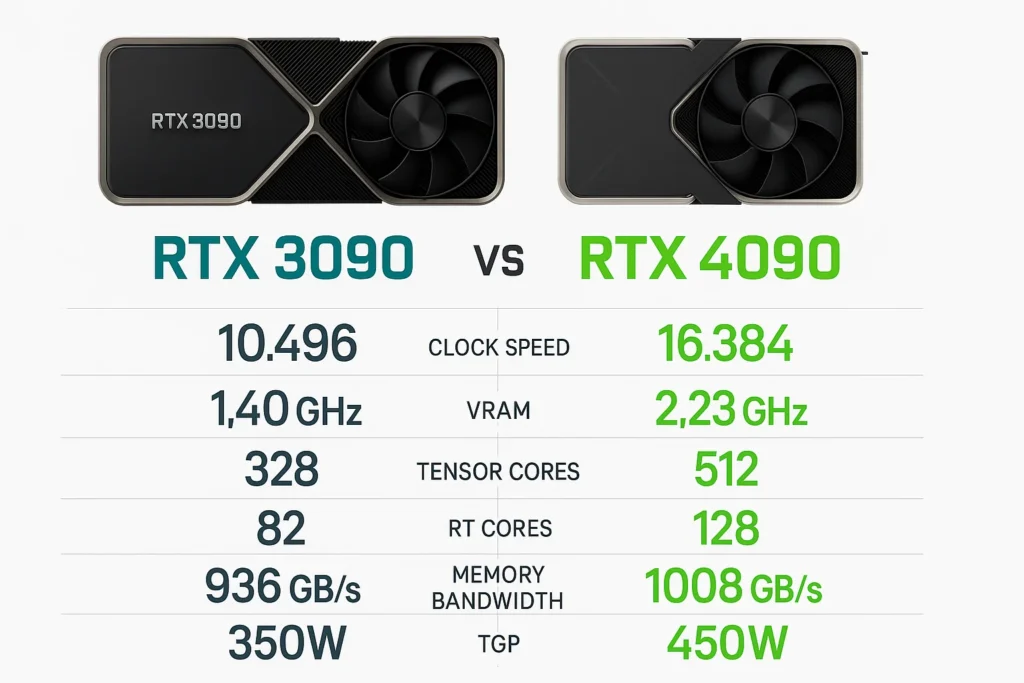
Core Specification Snapshot (CUDA Cores, Memory, TGP)
While both cards boast a massive 24GB of GDDR6X VRAM, the internal engine is vastly different. The 4090 has a higher core count, faster clock speeds, and a more efficient process node, which together yield a massive performance advantage. The 4090’s memory subsystem is also significantly faster, aiding in demanding scenarios like 4K gaming and professional rendering. For a complete breakdown of the official architecture and core specs, consult the Official NVIDIA GeForce RTX 4090 .
What is DLSS 3.0 Frame Generation, and Who Gets It?
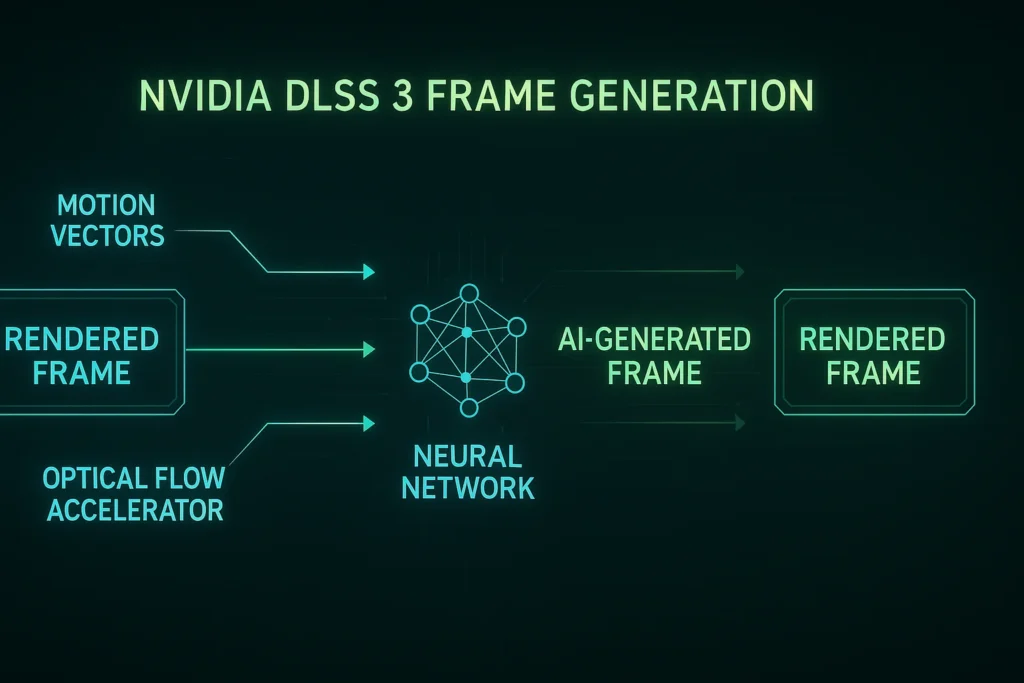
This is arguably the single largest differentiator. DLSS 3 (Deep Learning Super Sampling) is a revolutionary upscaling technology exclusive to the Ada Lovelace architecture (RTX 40 series and newer). It includes Frame Generation, an AI process that inserts entirely new, synthesized frames between traditionally rendered frames.
- The RTX 3090 supports DLSS 2 and the newer DLSS 3.5 (which includes Ray Reconstruction).
- The RTX 4090 supports the full suite, including DLSS 3 with Frame Generation.
This feature can often double frame rates at high resolutions, making the 4090 far more future proof and capable of hitting ultra high refresh rates in games where the 3090 might struggle.
Raw Performance Benchmarks A Tale of Two Tiers
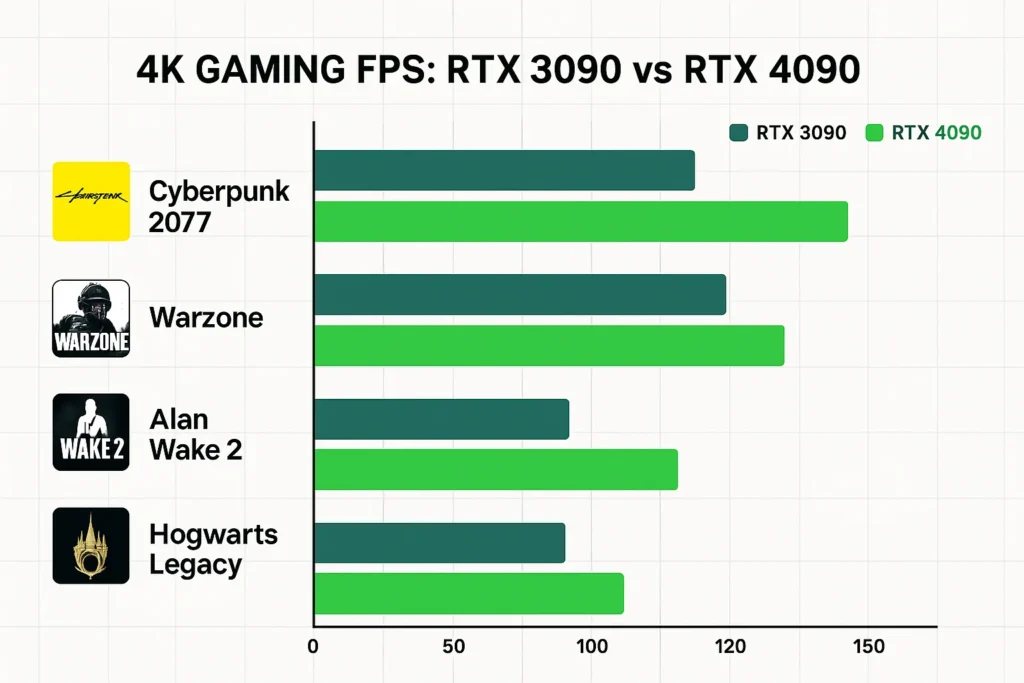
When comparing the two flagship cards, the RTX 4090 is unequivocally faster. In most scenarios, it offers an average performance uplift of 60% to 90% over the RTX 3090.
Native 4K Gaming FPS Comparison (Rasterization)
For traditional gaming (rasterization) at 4K resolution, the RTX 4090 easily maintains frame rates over 100 FPS in almost every title, even without DLSS. The RTX 3090 is still a strong 4K gaming card in 2025, but it may often fall into the 60 to 80 FPS range in demanding modern games. This difference impacts those with high refreshrate 4K monitors who want to maximize their display capabilities.
The Ray Tracing Gap Why the 4090 Dominates
The gap widens significantly when Ray Tracing is enabled. The 4090’s third gen RT cores are vastly more powerful and efficient than the 3090’s second gen cores.
- 3090 Ray Tracing: Often requires aggressive use of DLSS 2 to maintain playable frame rates at 4K.
- 4090 Ray Tracing: Can handle demanding RT settings at 4K and benefit from DLSS 3‘s Frame Generation to push performance into triple digits. The 4090 is truly the first card built for uncompromising ray traced gaming. You can review detailed side by side performance metrics from a trusted source, such as Tom’s Hardware GPU BenchUmarks Hierarchy.
Is the 3090 Still a 4K GPU in 2025?
Yes, the RTX 3090 remains an excellent 4K GPU for mainstream titles and even demanding games, provided you are comfortable enabling DLSS 2. If your target is a solid 60+ FPS experience, the 3090 still delivers tremendous value, particularly if you are considering the used market price.
Professional Workloads AI, Rendering, and VRAM
For content creators, data scientists, and developers, these cards are powerful tools, not just gaming devices. The sheer amount of VRAM (24GB on both) makes them excellent for large projects, high resolution textures, and complex models.
Creative Applications (Blender, Premiere Pro)
For applications like Blender, Maya, and Adobe Premiere Pro, the RTX 4090 offers significant gains. Its faster CUDA cores and higher clock speeds drastically cut down rendering and export times.
- Video Editing: The 4090 includes dual eighth generation NVIDIA Encoders (NVENC), making video export up to two times faster than the 3090’s single NVENC.
- 3D Rendering: In tests like Blender rendering, the 4090 typically completes tasks in about half the time of the 3090.
AI Performance and LLM Training Capabilities
For deep learning, AI, and LLM training, the 4090 maintains its lead. While both cards have 24GB of VRAM, the 4090’s fourth generation Tensor cores are fundamentally more efficient. For enthusiasts running large Stable Diffusion models or fine tuning local language models, the 4090 provides faster iteration times, which translates directly to saved hours of work.
VRAM Is 24GB the Same on Both Cards?
While both feature 24GB of GDDR6X, the implementation is different. The RTX 4090 has a faster memory clock and higher memory bandwidth (1008 GB/s vs. 936 GB/s), which is crucial for VRAM intensive tasks like 8K texture editing or complex computational fluid dynamics (CFD) simulations.
Power Efficiency and Build Requirements
The physical requirements of these GPUs are a critical part of the buying decision, particularly when upgrading your entire PC build.
Power Consumption (TGP) and Running Costs
The RTX 3090 has a high Total Graphics Power (TGP) of 350W. The RTX 4090 has an even higher TGP of 450W, but its performance per watt is dramatically superior due to the Ada Lovelace architecture.
- Efficiency: The 4090 delivers almost double the performance for only a 28% increase in power draw. This makes the 4090 far more power efficient.
- Running Costs: Over years of heavy use, the difference in power draw can impact your utility bill, though the 4090’s superior performance balances this out.
The Hidden Cost PSU and Case Size Requirements
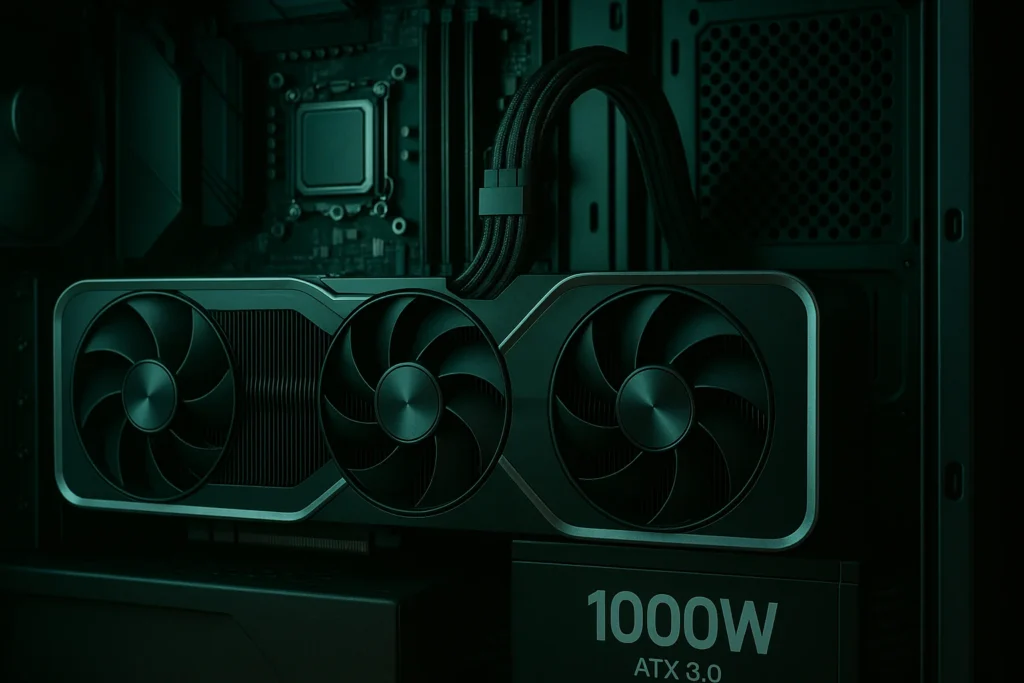
This is a major consideration for the 4090.
- Power Supply Unit (PSU): NVIDIA recommends an 850W PSU for the 3090 and a massive 1000W PSU for the 4090. If you are upgrading to the 4090, you may need a new PSU, increasing the total cost of ownership.
- Size: The RTX 4090 is a notoriously large card, often requiring a full tower or specialized mid tower case. The 3090 is also large but generally more accommodating for existing chassis. For more details on the RTX 3090’s initial specs and power requirements, check the Official NVIDIA GeForce RTX 3090 .
Pricing and Value in the 2025 Market
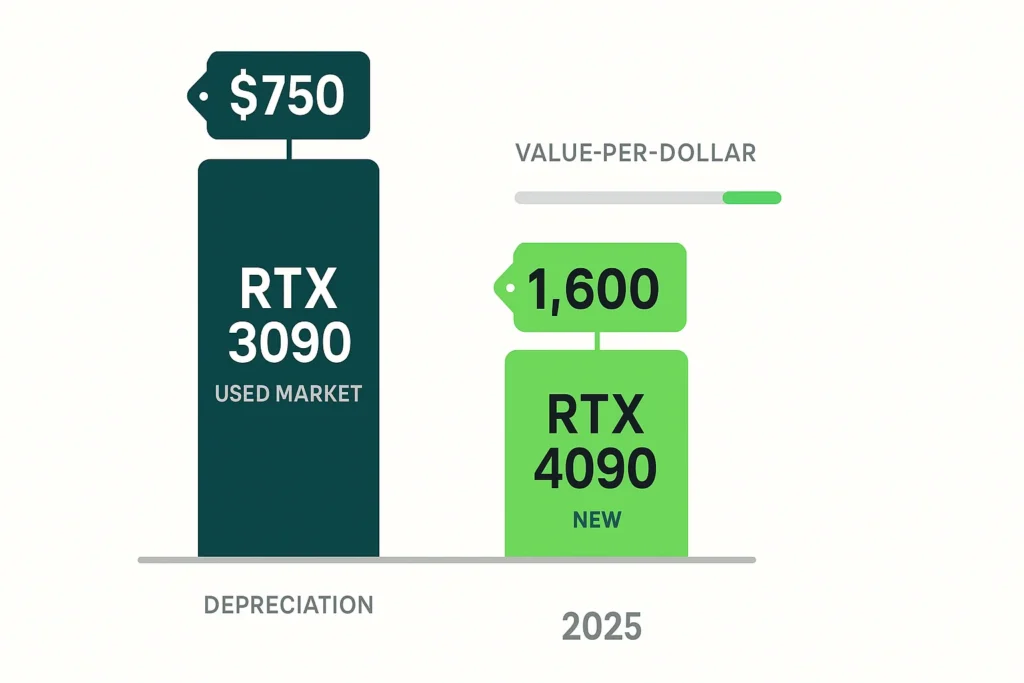
The year 2025 dramatically shifts the value proposition. The RTX 3090 is no longer available at MSRP, but rather on the used market.
Current New vs. Used Market Pricing
- RTX 4090: Still sold as new, with prices remaining near or above the original MSRP due to its flagship status. Its high price means it is a significant investment.
- RTX 3090: Primarily sold on the used market. Its used market price has dropped significantly from its peak, offering tremendous bang for your buck performance. For buyers on a tighter budget, a used 3090 offers a high end experience for sometimes less than half the cost of a new 4090. [Link: used GPU buying guide]
Longevity and Future Proofing for the Next Three Years
Future Proofing is all about architecture. The RTX 4090 is substantially more future proof because of two key features:
- DLSS 3 and Frame Generation: As games become more demanding, DLSS 3 will become essential for maintaining high frame rates.
- Raw Performance Headroom: The 4090’s massive performance lead ensures it can handle next generation AAA titles longer than the 3090.
If you plan to keep the card for 3+ years and game at 4K, the 4090 is the safer long term GPU upgrade investment.
Final Verdict Which GPU is Right for You?
The final choice between the RTX 3090 vs RTX 4090 is not just about performance metrics it’s about matching the card to your budget, your existing PC, and your specific use case in 2025.
Who Should Stick with Buy the RTX 3090?
- Budget Conscious 4K Gamers: You want a great 4K experience but cannot justify the cost of the 4090 and its associated PSU case upgrades.
- Creative Professionals on a Budget: You need 24GB of VRAM for professional workflows (like high res texture baking or large video projects) but are okay with slightly longer rendering times.
- Existing 3090 Owners: Unless you absolutely need the massive performance uplift of the 4090 for competitive gaming or timesensitive professional work, an upgrade from a 3090 to a 4090 is likely too expensive for the incremental gain.
Who Should Upgrade to Invest in the RTX 4090?
- The Uncompromising Enthusiast: You demand the absolute highest FPS in every title, including those with full Ray Tracing.
- AI or Machine Learning Experts: Your income or research relies on the fastest possible iteration speed for models and data sets.
- High Refresh Rate 4K Users: You want to consistently hit 100+ FPS on a high refresh rate 4K monitor. The inclusion of DLSS 3 makes this possible. For deeper insights into the 4090’s impact on AI and deep learning, review dedicated analysis like the one at Best GPUs for AI RTX 3090 vs 4090 Benchmarks.
Conclusion
The RTX 4090 is the reigning performance champion, it is a generational leap in power and efficiency, especially with DLSS 3 and enhanced Ray Tracing. However, the RTX 3090 remains an incredibly powerful, viable 4K gaming card in 2025, especially on the used market. The RTX 3090 vs RTX 4090 choice comes down to one simple question: Do you value maximum, future proofed performance above all else, or do you seek the best high end value today? Choose the 4090 for the pinnacle of performance and longevity, or the 3090 for a more balanced, budget friendly high end experience.
“While our main focus is on the flagship RTX 3090 vs RTX 4090 battle, not every user requires this level of performance. For those on a tighter budget seeking excellent value in the mid-range category, we have a separate guide: find out if the RTX 3060 graphics card is still worth it in 2025.”
FAQ Section
Is the RTX 3090 still worth buying for 4K gaming in 2025?
Yes. The 3090 is still excellent for 4K gaming, especially when using DLSS 2. If purchased at a good used market price, it offers great value.
How much power does the RTX 4090 need compared to the RTX 3090?
The RTX 4090 requires a much larger power supply, typically 1000W, compared to the 3090’s recommended 850W, and consumes about 100W more power under load.
Which GPU is better for video editing and 3D rendering?
The RTX 4090 is significantly better due to its faster CUDA cores and dual NVENC encoders, which can cut rendering and export times in half compared to the 3090.
Can the RTX 3090 use DLSS 3 Frame Generation?
No, DLSS 3 Frame Generation is a hardware locked feature of the Ada Lovelace architecture (RTX 40 series). The 3090 only supports DLSS 2 and the newer DLSS 3.5 Ray Reconstruction feature.
What is the real world FPS difference between the 3090 and 4090 at 4K resolution?
The RTX 4090 delivers an average of 60% to 90% higher frame rates than the RTX 3090 in most modern, demanding titles at 4K, a gap that widens further with Ray Tracing enabled.