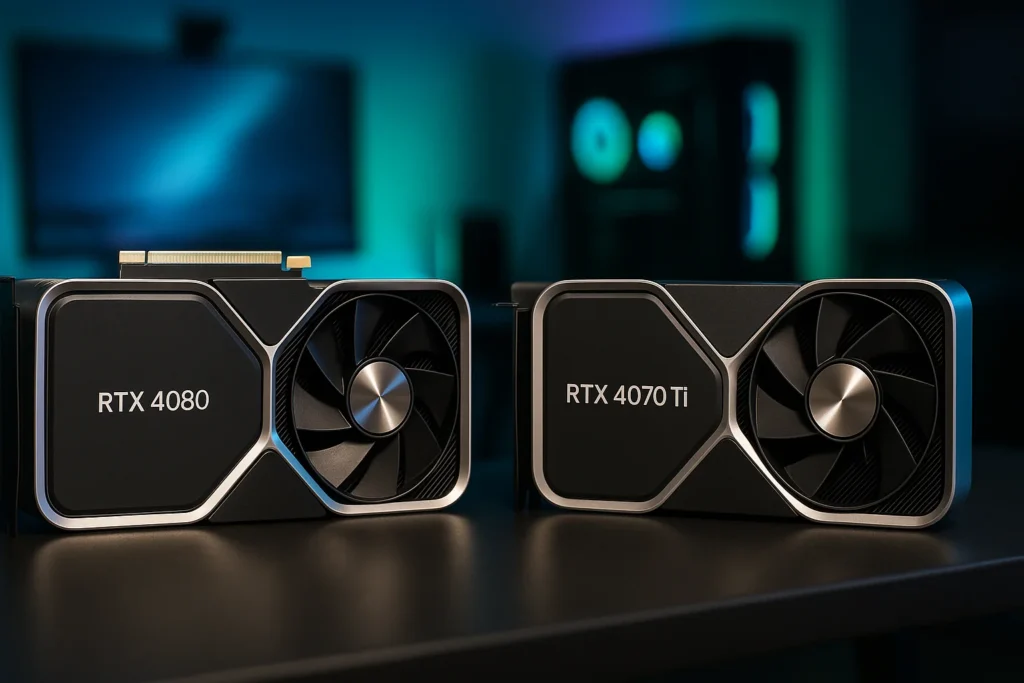

The search for the ultimate graphics card often boils down to balancing raw power with fiscal sense. In the competitive high end market, two cards from the NVIDIA GeForce RTX 40 Series stand out the RTX 4080 and the RTX 4070 Ti. These cards, based on the impressive Ada Lovelace architecture, offer significant generational leaps, but their price differences are substantial. To help you make the smartest upgrade, we’re pitting them against each other in this definitive RTX 4080 vs RTX 4070 Ti comparison, focusing on the ultimate question of which GPU offers the best value GPU for gamers in the USA today.
Core Specifications 4070 Ti vs 4080 Architectural Differences
Diving into the silicon, the difference between these two cards is more than just a number change it’s a significant architectural gulf. Understanding the specifications is the foundation for appreciating their real world performance gap. The RTX 4080 utilizes a much more complete version of the AD103 GPU chip than the 4070 Ti does of its AD104 chip.
CUDA Cores, Clock Speed and Processing Power
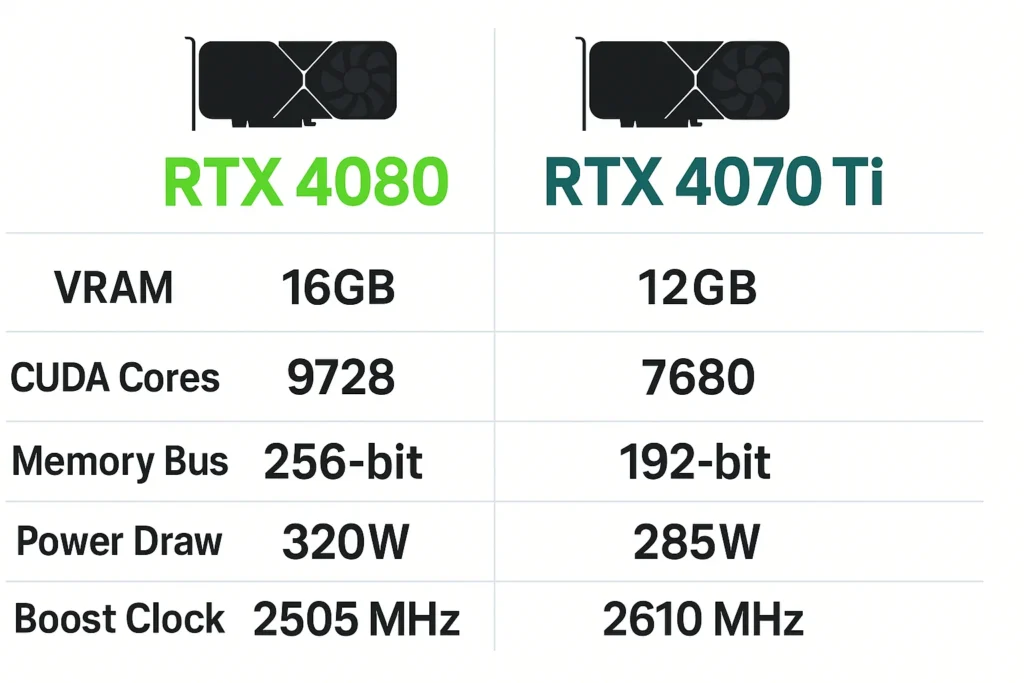
The RTX 4080 features 9,728 CUDA cores, a massive leap over the 7,680 CUDA cores found in the RTX 4070 Ti. CUDA cores are the engine of the GPU, responsible for parallel processing more cores almost always mean higher performance. While the boost clock speeds are comparable, the sheer number of processing units gives the 4080 a raw processing advantage of approximately 25 to 30% over the 4070 Ti. This overhead is critical for demanding tasks like ray tracing and higher resolutions.
Memory Matters 12GB VRAM vs 16GB and Bus Width
The memory configuration is perhaps the most debated difference. The RTX 4080 comes equipped with 16GB of GDDR6X VRAM on a 256 bit memory bus. In contrast, the RTX 4070 Ti has 12GB of GDDR6X VRAM on a narrower 192 bit bus. The memory bus width is crucial as it determines how quickly the GPU can access its VRAM. The 256 bit interface on the 4080 provides a higher memory bandwidth, which is essential for rendering complex textures and large amounts of data at 4K resolution, making it much more capable in memory intensive scenarios.
Power Draw and PSU Requirements
The power requirements also reflect the processing capacity. The RTX 4080 has a Total Graphics Power (TGP) of 320W, requiring a minimum recommended 750W PSU. The RTX 4070 Ti is more efficient, with a TGP of 285W, and generally needs a 700W power supply. This difference impacts not only your electricity bill but also your system’s overall thermal output and cooling needs.
1440p Performance The Sweet Spot for High Refresh Gaming
For the majority of gamers in the USA, 1440p is currently the desired high performance resolution. Both GPUs are exceptionally capable here, delivering a fantastic experience.
Frame Rate Benchmarks in Top AAA Games
In modern titles at 1440p, the RTX 4070 Ti often achieves well over 100 FPS, making it an outstanding card for 1440p high refresh rate gaming. The RTX 4080 is, predictably, faster, usually offering an average frame rate increase of 20% to 25% over the 4070 Ti in rasterization. However, this level of performance increase often moves the frame rate from “excellent” to “overkill” on standard 144Hz monitors.
The Importance of High Refresh Rate Monitors
If you own a 240Hz or 360Hz monitor, the 4080’s extra power can translate directly into higher, smoother frame rates, justifying the cost. For a typical 144Hz monitor, the 4070 Ti’s performance is often indistinguishable from the 4080’s, especially when factoring in the use of NVIDIA’s DLSS 3 Frame Generation.
4K Gaming Battle Where the 4080 Takes the Lead
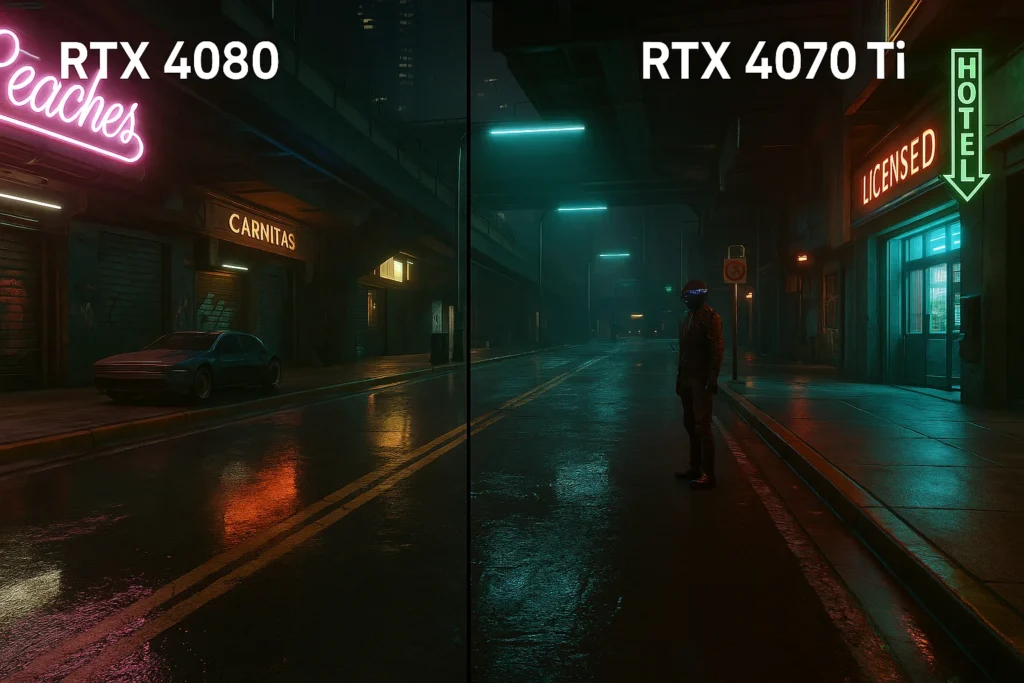
When pushing to 4K resolution, the demands on both the GPU core and the VRAM increase exponentially. This is where the architectural differences become most apparent.
4K Rasterization Performance Results
At 4K, the 4080 truly establishes its dominance. Its wider 256 bit memory bus and higher CUDA core count allow it to handle the immense texture and shading loads much more efficiently. In the most demanding games, the RTX 4080 can be 30% to 35% faster than the 4070 Ti. This difference often translates to the 4080 achieving a solid 60+ FPS experience, whereas the 4070 Ti might dip into the 50s, forcing the user to lower settings. The 4080 is genuinely the superior 4K Gaming performance card.
Ray Tracing and DLSS 3 Frame Generation Comparison
Ray Tracing performance is heavily taxing on the GPU, and the performance gap widens further here. The RTX 4080 handles Ray Tracing significantly better due to its greater RT core count and memory bandwidth. Crucially, both cards support DLSS 3 Frame Generation. This AI upscaling and frame creation technology is a game changer, effectively bridging the gap between cards. However, the 4080 starts from a higher native frame rate baseline, meaning its final, DLSS enhanced frame rate is simply much higher.
Value Analysis The Price to Performance Ratio Breakdown
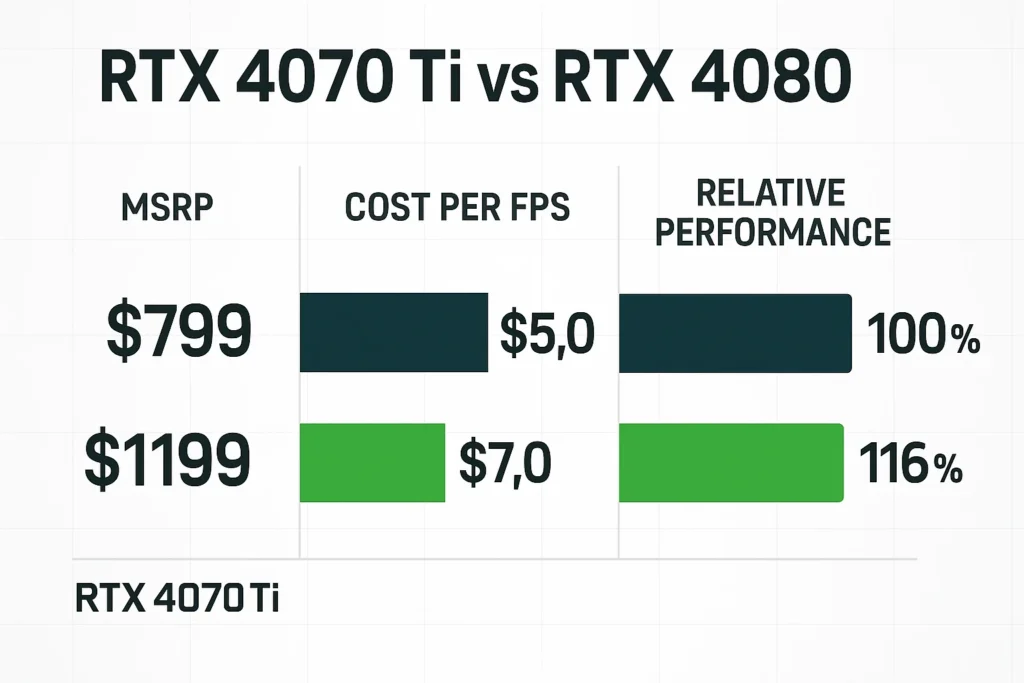
The decision ultimately rests on the price to performance ratio. The official MSRP for the RTX 4080 is 1,199, while the RTX 4070 Ti starts at 799.
MSRP and Real World Street Price Check
The $400 price difference represents the biggest hurdle for the 4080. While the RTX 4080 is roughly $30 faster than the 4070 Ti, it is approximately $50% more expensive. In the real world, street prices fluctuate, but the general principle holds you are paying a hefty premium for the highest end performance.
Cost per FPS Metric Is the 4080 Worth the Premium?
When calculating the cost per FPS (a common metric for determining the best value GPU), the RTX 4070 Ti consistently emerges as the more sensible purchase at 1440p. Its price to performance ratio is much stronger. The 4080 is only “worth” the premium if you are strictly focused on 4K gaming and demand settings that utilize its full 16GB VRAM and wider bus. For most users, the 4070 Ti provides 80% of the 4080’s 1440p performance for 65% of the price.
FutureProofing VRAM and Longevity Concerns
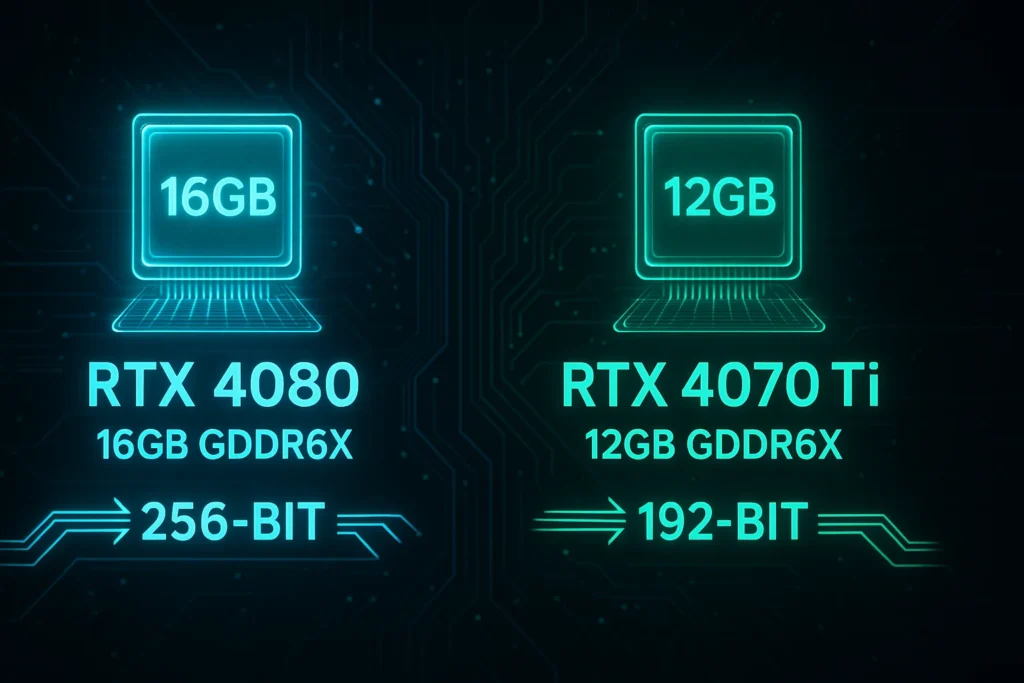
For longevity, the amount of VRAM size is the most important spec to consider. New, graphically intensive games are becoming more demanding on video memory.
Is 12GB VRAM Enough for Games in 2025 and Beyond?
The 4070 Ti’s 12GB VRAM is sufficient for almost all current titles at 1440p. However, when gaming at 4K or using high resolution texture packs, 12GB can become a limitation and cause performance stuttering (or “VRAM bottlenecking”). The 16GB buffer on the 4080 provides peace of mind that the card will be future proofed against rising VRAM demands for the next 3 to 5 years, especially at 4K.
The Advantage of a Wider Memory Bus
The 256 bit memory bus of the RTX 4080 is another key advantage for future proofing. As game assets and textures become larger, the speed at which the GPU can access memory is critical. The 4080’s wider bus mitigates potential memory bottlenecks more effectively than the 4070 Ti’s 192 bit bus.
Beyond Gaming Productivity and Content Creation
While gaming is the primary focus, the GeForce RTX 40 Series cards are also powerful tools for creators.
NVENC Performance for Streaming and Video Encoding
Both the RTX 4080 and RTX 4070 Ti use the same 8th gen NVIDIA Encoder (NVENC), which offers superior quality and efficiency for live streaming and video exporting. In this regard, the performance difference is minimal, meaning either card is an excellent choice for streamers and video editors.
CUDA Acceleration for 3D Rendering and AI Tasks
For professional workloads like 3D rendering (Blender, Cinema 4D) or AI development, the extra CUDA cores on the RTX 4080 translate directly into faster render times and processing speeds. While the 4070 Ti is capable, the 4080’s superior core count makes it the preferred choice for professionals who rely on GPU acceleration for their livelihood.
AIB Models, Thermals and Physical Size
The cooling solution is vital for maintaining peak performance.
Comparing Founders Edition vs Custom Partner Cards
Both GPUs are available as NVIDIA Founders Edition and custom cards from Add in Board (AIB) partners (like MSI, ASUS, and Gigabyte). The AIB models often feature massive, triple fan cooling solutions. Due to the 4080’s higher TGP, its custom cards are typically larger and thicker than the 4070 Ti’s, demanding more case space and better airflow.
Physical Footprint and Case Compatibility
It’s important to measure your PC case before purchasing either GPU. While the 4070 Ti is large, the 4080 is often one of the largest GPUs on the market, frequently taking up 3 or even 4 expansion slots. The massive coolers are necessary but can be a tight fit in smaller or mid tower cases.
Final Who Should Buy the 4080 and Who Should Buy the 4070 Ti?
The RTX 4080 vs RTX 4070 Ti decision depends entirely on your target resolution and budget.
Recommendation for the 1440p Value Seeker
If your budget is under 1,000$ and you primarily game at 1440p, the RTX 4070 Ti is the undisputed best value GPU. It offers incredible 1440p high refresh rate performance, excellent power efficiency, and full support for DLSS 3. It’s the smart choice for most users. RTX 4070 Ti Review
Recommendation for the No Compromise 4K Gamer
If your goal is native 4K gaming, the highest settings, and true future proofing (especially the 16GB VRAM), the RTX 4080 is worth the premium. It delivers the performance necessary to maintain high frame rates in the most demanding titles, especially with Ray Tracing enabled.
Conclusion
Both the RTX 4080 and the RTX 4070 Ti are exceptional GPUs built on the Ada Lovelace architecture, bringing significant performance and efficiency gains. The 4070 Ti is the clear winner in the price to performance ratio at 1440p, offering most of the performance for significantly less money. The 4080 justifies its higher cost through superior 4K performance, more VRAM, and greater longevity. Ultimately, the RTX 4080 vs RTX 4070 Ti decision comes down to your budget and gaming resolution. Choose wisely.
If you are looking for an even more powerful, no holds barred GPU experience, you may be stepping beyond these two cards. For those with maximum budget flexibility who are interested in the ultimate performance tier, we recommend reading our RTX 3090 vs RTX 4090 buy guide for a deeper look at the flagship GPUs.
FAQ Section
Is the RTX 4080 worth the extra money over the RTX 4070 Ti?
Yes, if you are a 4K gamer seeking to maximize frame rates and futureproof with 16GB of VRAM. No, if you primarily game at 1440p, where the 4070 Ti offers a much better cost per FPS value.
What is the best GPU for 4K gaming between the 4070 Ti and 4080?
The RTX 4080 is the unequivocally better card for native 4K gaming, consistently delivering higher frame rates and better performance stability due to its superior memory bandwidth and 16GB VRAM.
Does the 4070 Ti have enough VRAM for modern games?
For 1440p gaming, 12GB is sufficient for all current titles. However, at 4K or with Ultra texture packs, 12GB can become a limitation in the most demanding AAA titles.
What power supply (PSU) do I need for an RTX 4080 or 4070 Ti?
We recommend a minimum 750W PSU for the RTX 408$ and a 700W PSU for the RTX 4070 Ti to ensure stable performance and headroom for the rest of your system components.
What are the key differences between the 4070 Ti’s 12GB VRAM and the 4080’s 16GB VRAM?
Beyond the capacity difference, the RTX 4080 uses a wider 256bit memory bus, giving it significantly higher memory bandwidth than the 4070 Ti’s 192bit bus. This is the main factor in 4K performance stability.